Antibody detailed product information
| Code No. | M087-3 | |
| Anti-Caspase-3 (Human) mAb | ||
| Size | 100 µL (1 mg/mL) | |
| Availability (in Japan) | 1-9
(In Japan at 17:33, Apr 26, 2024 in JST) |
|
| Clonality | Monoclonal | |
| Clone | 1F9 | |
| Isotype (Immunized Animal) |
Mouse IgG1 | |
| Applications | WB 1 µg/mL IH 10 µg/mL |
|
| Immunogen (Antigen) |
Recombinant Human caspase-3 | |
| Reactivity [Gene ID] | Human[836], Mouse(-), Rat(-) |
|
| Storage buffer | 1 mg/mL in PBS/50% glycerol, pH 7.2 | |
| Storage temp. | -20°C | |
| Conjugate | Unlabeled | |
| Manufacturer | MBL | |
| Alternative names | CASP3 | |
| Background | Caspase-3 (also known as CPP32, Yama, apopain) is a key member of the caspase family of cysteine proteases. Caspase-3 exists in cells as an inactive 32 kDa proenzyme. During apoptosis procaspase-3 is processed at aspartate residues by self-proteolysis and/or cleavage by upstream caspases, such as caspase-6, -8, or -9. The processed form of caspase-3 consists of large (17 kDa) and small (12 kDa) subunits which associate to form the active tetrameric enzyme tetramer (a pair of heterodimers). The active caspase-3 proteolytically cleaves and activates other caspases, as well as relevant targets in the cells (e.g., PARP, SREBPs, and DFF). Activation of procaspase-3 stands at a point of convergence for the two major types of apoptosis signaling pathways-those linked to cell surface death receptors and those linked to mitochondrial release of cytochrome c. | |
| Related products | M097-3 Anti-Caspase-3 (Human) mAb M059-3 Anti-Caspase-10 (Human) mAb M029-3 Anti-Caspase-4 (Human) mAb M060-3 Anti-Caspase-5 mAb M053-3 Anti-Caspase-7 mAb M032-3 Anti-Caspase-8 (Human) mAb M058-3 Anti-Caspase-8 (Human) mAb M054-3 Anti-Caspase-9 mAb M044-3 Anti-XIAP (MIHA/ILP-a) mAb |
|
| Product category | Research area:Apoptosis | |
| Data | 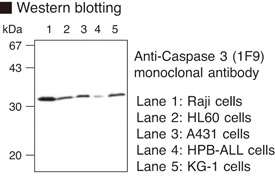 |
|
- The availability is based on the information in Japan at 17:33, Apr 26, 2024 in JST.
- The special price is shown in red color.
- Please note that products cannot be ordered from this website. To purchase the items listed in this website, please contact us or local distributers.
- Abbreviations for applications:
WB: Western Blotting, IH: Immunohistochemistry, IC: Immunocytochemistry, IP: Immunoprecipitation
FCM: Flow Cytometry, NT: Neutralization, IF: Immunofluorescence, RIP: RNP Immunoprecipitation
ChIP: Chromatin Immunoprecipitation, CoIP: Co-Immunoprecipitation
DB: Dot Blotting, NB: Northern Blotting, RNA FISH: RNA Fluorescence in situ hybridization - For applications and reactivity:
*: The use is reported in a research article (Not tested by MBL). Please check the data sheet for detailed information.
**: The use is reported from the licenser (Under evaluation or not tested by MBL).
- For storage temparature: RT: room temparature
- Please note that products in this website might be changed or discontinued without notification in advance for quality improvement.
 Copyright (C)2015 Medical & Biological Laboratories Co., Ltd. All Rights Reserve