


This site is for customers in Asia.
Customers in China & other regions, please go to Global page.

HOME >
Product search results > Code No. MEX002-3
Anti-CD63 (LAMP-3) mAb
Code No. MEX002-3




Anti-CD63 (LAMP-3) mAb

Availability (in Japan)
10 or more
(In Japan at 17:00,
Apr 25, 2024 in JST)
Size
100 µL (1 mg/mL)

 Citations
 Data Sheet
| Data |
|
||||
|---|---|---|---|---|---|
| Clonality | Monoclonal | Clone | C047-1 | ||
| Isotype (Immunized Animal) | Mouse IgG2bκ | ||||
| Applications |
|
||||
| Immunogen (Antigen) | human prostate carcinoma cell line (PC3) derived exosomes (prepared by ultracentrifugation from cultured supernatant) | ||||
| Reactivity [Gene ID] | |||||
| Storage buffer | 1 mg/mL in PBS/50% glycerol, pH 7.2 | ||||
| Storage temp. | -20°C | Conjugate | Unlabeled | Manufacturer | MBL |
| Alternative names | MIC3, MRP-1, BTCC-1, DRAP-27, TSPAN29, TSPAN-29 | ||||
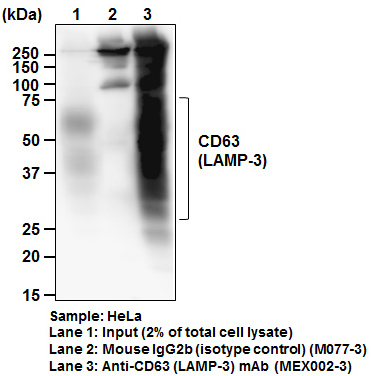
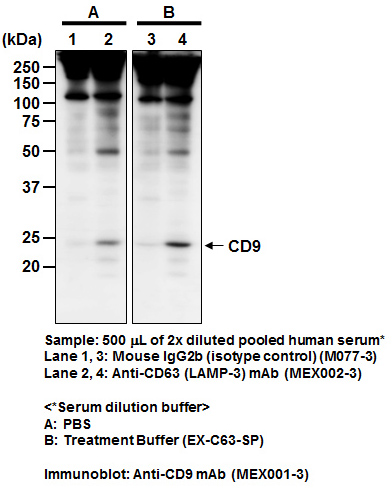
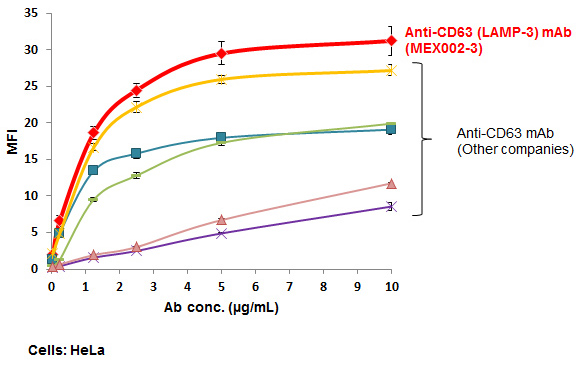
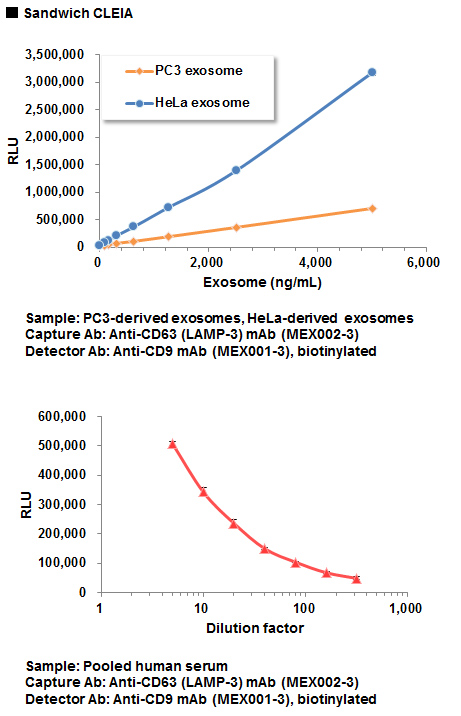
| Background | CD63 antigen, also known as LAMP-3, is a tetraspanin characterized by four transmembrane domains and a member of the transmembrane 4 superfamily. CD63 is the first characterized tetraspanin. CD63 has broad tissue distribution and may play multiple roles in a variety of cellular processes such as immune response and tumorigenesis, but its function has not been elucidated entirely. It is reported that CD63 is abundant in tetraspanin-enriched microdomains (TEMs) and a certain type of cellular compartment, such as late endosomes and lysosomes, while the tetraspanin-rich small lipid bilayers are secreted into extracellular fluid as a certain type of extracellular vesicles, called exosome. Because of various exosome features, CD63, one of the representative exosome surface proteins, is thought to be related to intercellular communication. | ||||
| Related products | D263-3 Anti-CD63 (LAMP-3) (Mouse) mAb M076-3 Mouse IgG2a (isotype control) M077-3 Mouse IgG2b (isotype control) MEX002-3 Anti-CD63 (LAMP-3) mAb MEX003-3 Anti-CD81 (TAPA1) mAb 3190 Magnetic Rack MJS002V2 Protein G-Magnetic Beads MEX001-6 Anti-CD9 mAb-Biotin MEX002-6 Anti-CD63 (LAMP-3) mAb-Biotin MEX003-6 Anti-CD81 (TAPA1) mAb-Biotin MEX001-3 Anti-CD9 mAb MEX001-4 Anti-CD9 mAb-FITC MEX002-4 Anti-CD63 (LAMP-3) mAb-FITC MEX003-4 Anti-CD81 (TAPA1) mAb-FITC MEX001-12 Anti-CD9 mAb-ALP MEX002-12 Anti-CD63 (LAMP-3) mAb-ALP MEX003-12 Anti-CD81 (TAPA1) mAb-ALP |
||||
| Citations |
Western Blotting
|
||||
| References |
|
||||
| Product category |
|
||||





- The availability is based on the information in Japan at 17:00, Apr 25, 2024 in JST.
- The special price is shown in red color.
- Please note that products cannot be ordered from this website. To purchase the items listed in this website, please contact us or local distributers.
- Abbreviations for applications:
WB: Western Blotting, IH: Immunohistochemistry, IC: Immunocytochemistry, IP: Immunoprecipitation
FCM: Flow Cytometry, NT: Neutralization, IF: Immunofluorescence, RIP: RNP Immunoprecipitation
ChIP: Chromatin Immunoprecipitation, CoIP: Co-Immunoprecipitation - For applications and reactivity:
*: The use is reported in a research article (Not tested by MBL). Please check the data sheet for detailed information.
**: The use is reported from the licenser (Under evaluation or not tested by MBL).
- For storage temparature: RT: room temparature
- Please note that products in this website might be changed or discontinued without notification in advance for quality improvement.